
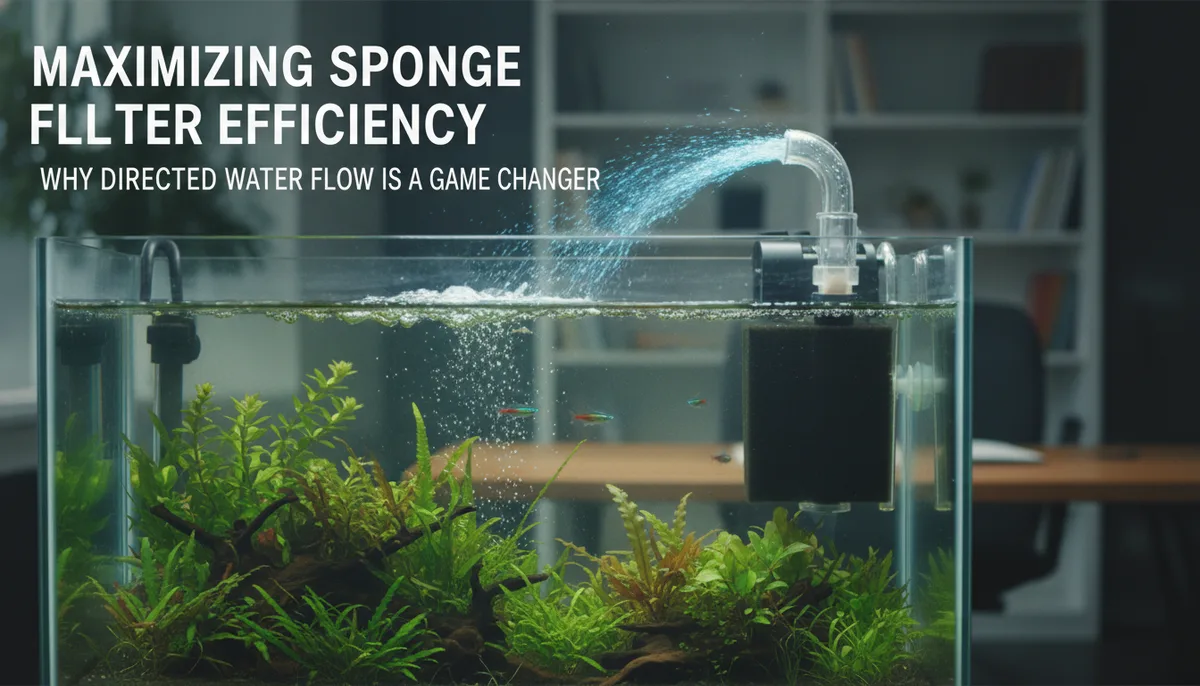
Maximizing Sponge Filter Efficiency: Why Directed Water Flow is a Game Changer
Sponge filters have long been the "secret weapon" of the aquarium industry. From massive wholesale facilities and fish farms to the dedicated breeding racks of seasoned hobbyists, these simple devices are responsible for sustaining millions of ornamental fish. Their popularity stems from a trifecta of benefits: they are incredibly cost-effective, nearly impossible to break due to a lack of complex mechanical parts, and they provide a safe environment for the most delicate inhabitants, such as dwarf shrimp and newly hatched fry.
However, even the most reliable tools have their limitations. The most common critique of the traditional sponge filter is its "gentle" nature. While a soft current is ideal for a Betta or a colony of Neocaridina shrimp, it can lead to stagnant water in larger or more heavily decorated environments. Without adequate circulation, an aquarium can suffer from "dead zones," nutrient imbalances, and unsightly waste buildup.
To solve this, we must look at how water moves through the filter and, more importantly, how it exits. By modifying the way air and water are discharged, we can transform a standard sponge filter into a high-performance circulation engine.
The Mechanics of Sponge Filtration: Beyond the Bubbles
To understand how to improve a sponge filter, we first need to understand its basic physics. A sponge filter operates on the principle of air displacement. An external air pump—such as the powerful aquarium air pump—pushes air through a line into the hollow core of the filter. As these air bubbles rise through the central uplift tube, they create a vacuum effect, pulling water along with them.
As water is drawn into the filter, it must pass through the porous foam walls. This process provides two distinct types of filtration:
- Mechanical Filtration: The sponge physically traps floating particles, uneaten food, and fish waste.
- Biological Filtration: The massive surface area within the sponge pores provides a home for billions of beneficial nitrifying bacteria. These bacteria consume toxic ammonia and nitrite, converting them into less harmful nitrate.
The "exhaust" of this system is the air-and-water mixture that exits the top of the tube. In a standard configuration, this exit is a vertical opening. The bubbles rise straight up and pop at the surface. While this works, it is mathematically inefficient for moving water across the horizontal expanse of a rectangular tank.
The Problem with Vertical Flow: Dead Zones and Mulm
In a typical aquarium setup, the sponge filter is tucked away in a back corner to keep the aesthetic focus on the fish and plants. If you are using a high-clarity tank, such as those found in our guide to the Best Rimless Aquariums for a Modern Home Aesthetic, you likely want the equipment to be as unobtrusive as possible.
The issue with corner placement and vertical discharge is that the "pull" of the filter is localized. Water is drawn from the immediate vicinity, and the bubbles create a localized "chimney" of movement. In a tank filled with driftwood, rocks, and dense plantings, the water on the opposite side of the tank—or even just in the front center—may remain almost entirely still.
These stagnant areas are where "mulm" (the brown, organic dust consisting of broken-down waste) tends to settle. Not only is mulm unsightly when it collects on your substrate, but it can also become a breeding ground for cyanobacteria or BBA (Black Brush Algae) if left undisturbed. Furthermore, poor circulation means that heat from your Eheim Jager Heater or nutrients for your plants may not be distributed evenly, leading to cold spots or localized nutrient deficiencies.
Introducing the Easy Flow: A Simple Engineering Solution
To address the limitations of vertical discharge, Aquarium Co-Op developed the "Easy Flow" uplift tube. This is a curved, adjustable attachment designed to redirect the energy of the rising bubbles. Instead of allowing the water to simply "plop" out of the top of the filter, the Easy Flow bends the exit at a 90-degree angle.
This simple change in geometry has a profound impact on the hydrodynamics of the tank. By shooting the water and bubbles horizontally across the surface, you create a directional current. This current acts like a conveyor belt, moving the top layer of water toward the opposite glass wall. When the water hits that wall, it is forced downward and back across the bottom of the tank, eventually returning to the sponge filter's intake.
This circular flow pattern—often called a "gyre"—is the key to a healthy ecosystem. It ensures that every drop of water in the tank eventually passes through the sponge, and it keeps debris suspended in the water column long enough for the filter to trap it.
Strategic Placement: The "Front-Wall Bounce" Technique
One of the most effective ways to use a directed uplift tube is to aim the spout toward the front glass of the aquarium.
Most hobbyists struggle with debris collecting right at the front of the tank, where it is most visible against the substrate. By aiming the Easy Flow spout toward the middle of the front wall, the current travels across the surface, hits the glass, and dives downward. This downward force pushes the mulm away from the front viewing area and moves it toward the back and middle of the tank.
This doesn't just make the tank look cleaner; it makes the filter more efficient. By physically moving the waste toward the sponge, you are reducing the amount of manual siphoning required during your weekly maintenance. This is especially helpful in planted tanks where you want to maintain high water quality to prevent issues like Potassium Deficiency, which can weaken plants and make them more susceptible to algae.
Enhancing Gas Exchange and Surface Agitation
Beyond moving physical debris, the Easy Flow uplift tube significantly improves the "breathing" of your aquarium. Fish and bacteria consume oxygen and produce carbon dioxide. For the tank to remain healthy, CO2 must escape at the surface, and O2 must enter. This process is called gas exchange.
A traditional sponge filter provides gas exchange primarily through the popping of bubbles at the surface. However, the Easy Flow increases the "surface velocity" of the water. As the water moves horizontally, it breaks the surface tension across a much larger area.
This has several practical benefits:
- Biofilm Prevention: It prevents the oily, shimmering film that often forms on the surface of low-flow tanks. This film is not only ugly but also acts as a barrier that slows down oxygen absorption.
- Floating Plant Management: If you use a floating plant corral, a directed flow can help keep your Duckweed, Frogbit, or Salvinia in one area of the tank, preventing them from blocking the light needed for your rooted plants.
- Temperature Uniformity: By pushing the surface water (which is often warmer due to LED Aquarium Lighting) downward, it helps maintain a consistent temperature throughout the entire water column.
Is a Sponge Filter Right for Your Setup?
While the Easy Flow modification makes the sponge filter much more versatile, it is important to choose the right size for your tank. Aquarium Co-Op offers these filters in various sizes, from "Nano" for small desktop tanks to "Large" for 55-gallon setups and beyond.
If you are keeping a high-energy "Scaper" tank with heavy fertilization and high-intensity light, you might still want to supplement a sponge filter with a small powerhead for extra flow. However, for 90% of freshwater hobbyists—especially those breeding fish or keeping community tanks—a sponge filter equipped with a directed uplift tube provides the perfect balance of safety and performance.
The beauty of this system lies in its simplicity. You are taking the most reliable filtration method in the world and adding a small piece of plastic that uses the laws of physics to work harder for you. It’s a low-cost, high-impact upgrade that results in clearer water, healthier fish, and a more vibrant aquarium.
By focusing on circulation and surface agitation, you aren't just filtering the water; you are creating a living, breathing environment that mimics the natural flow of streams and rivers. Whether you are a beginner setting up your first 10-gallon tank or a veteran managing a fish room, the transition to directed flow is one of the easiest ways to level up your fishkeeping game.