
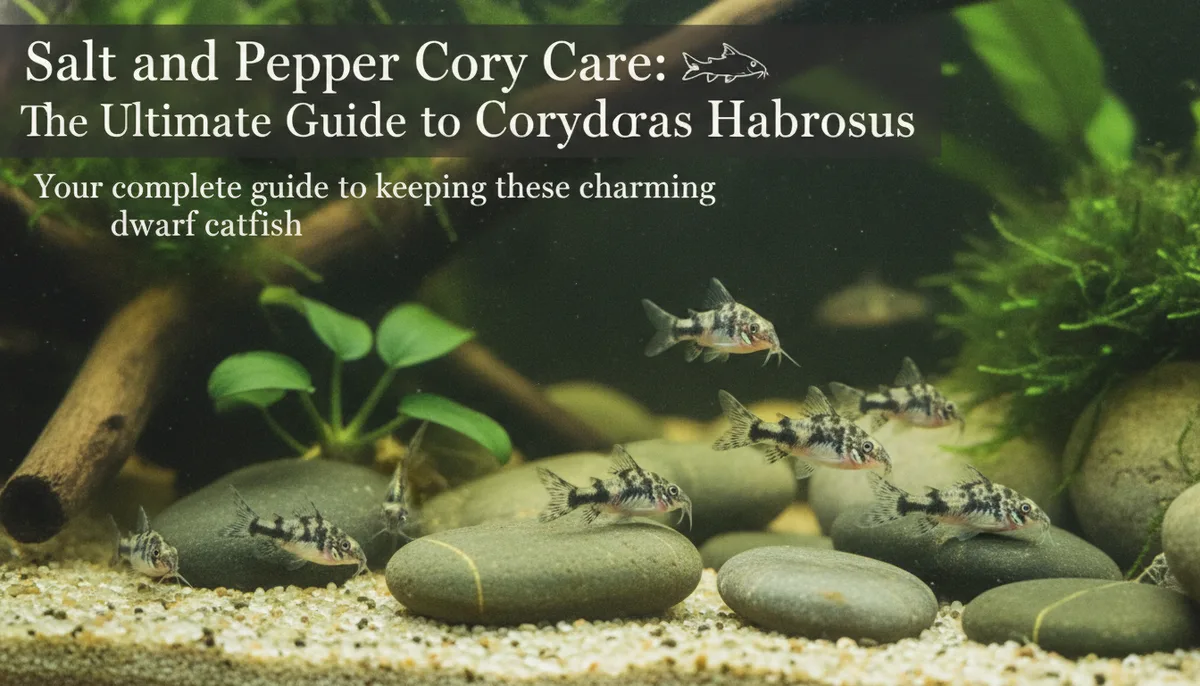
Salt and Pepper Cory Care: The Ultimate Guide to Corydoras Habrosus
Among the vast array of bottom-dwelling fish available to hobbyists, few capture the heart quite like the Corydoras family. Known for their "armored" scales and expressive faces, Cory catfish are a staple in the community aquarium. However, when space is at a premium or you are looking to design a delicate nano scape, the standard-sized Corydoras might feel a bit too bulky.
Enter the Salt and Pepper Cory (Corydoras habrosus).
This species is often cited as one of the most popular choices for enthusiasts because it packs all the personality of a large catfish into a tiny, 1.5-inch frame. Unlike other dwarf species that may spend their time hovering in the water column, the C. habrosus remains true to its roots, busily sifting through the substrate and providing constant movement at the bottom of the tank.
Understanding the "Dwarf" Corydoras Hierarchy
To provide the best care for these fish, you must first understand exactly what they are—and what they aren't. In the aquarium trade, the term "dwarf cory" is often used interchangeably for three different species. While they share similar sizes, their behaviors and appearances differ significantly.
- Corydoras habrosus (Salt and Pepper Cory): These are the largest of the dwarfs. They possess a silvery-tan body characterized by an uneven, horizontal black stripe and dark splotches across the head and back. Crucially, they are bottom-dwellers.
- Corydoras pygmaeus (Pygmy Cory): These have a more streamlined, silvery body with a thin, distinct horizontal black stripe. Unlike the Salt and Pepper Cory, Pygmy Corys spend much of their time swimming in the middle of the water column.
- Corydoras hastatus (Tail Spot Cory): These are identified by a prominent black spot at the base of the tail, flanked by two white dots. Like the Pygmy Cory, they are mid-water swimmers.
It is also vital to distinguish the Salt and Pepper Cory from the Peppered Cory (Corydoras paleatus). While the names are confusingly similar, the Peppered Cory grows to 2.5 inches and requires a much larger environment. If you are looking for a true nano fish, ensure you are specifically sourcing C. habrosus. For a broader look at how these compare to other small bottom-dwellers, check out our guide on The Best Small Catfish for Community Aquariums: A Complete Guide to Corys, Otos, and Beyond.
Designing the Ideal Habitat for C. habrosus
In the wild, Salt and Pepper Corys inhabit the flooded forests and slow-moving streams of Colombia and Venezuela. These environments are rich in organic matter, featuring dense tangles of tree roots and fallen leaves. Recreating this in the home aquarium is the key to seeing their natural, "silly" antics.
Substrate Choice
Because C. habrosus uses its delicate barbels (whiskers) to "sniff" out food beneath the surface, the choice of substrate is paramount. Sharp or large-grained gravel can wear down these barbels, leading to infections and stress.
aquarium sand for bottom dwellers
A soft sand substrate allows them to exhibit their natural sifting behavior safely. Watching a group of ten Corys "snuffle" into the sand simultaneously is one of the most rewarding sights in the hobby.
Plants and Decor
These fish thrive in "cluttered" environments. They feel most secure when they have overhead cover to hide from perceived predators. Live plants such as Anubias, Java Fern, and various Cryptocoryne species provide excellent hiding spots while maintaining high water quality.
If you are setting up a high-end display, you might consider Best Rimless Aquariums for a Modern Home Aesthetic to showcase the intricate patterns of these fish. To ensure your plants grow thick enough to provide the cover these Corys love, investing in quality lighting is essential. You can find our recommendations in the Best LED Aquarium Lighting for Planted Tanks: Budget vs. Professional Grade guide.
Water Parameters and Filtration
The Salt and Pepper Cory is remarkably hardy, thanks to its evolutionary history of surviving the changing water conditions of the South American rainy seasons. However, "hardy" does not mean "indestructible."
- Temperature: 70–78°F (20–26°C).
- pH: 6.0–8.0.
- Hardness: Soft to moderately hard water.
One unique physiological trait of Corydoras is their ability to breathe atmospheric air. You may occasionally see your Salt and Pepper Cory dart to the surface, take a quick gulp of air, and race back down. This is a normal behavior called intestinal respiration. However, if they are doing this constantly, it may be a sign of low oxygen levels in the water, and you should check your filtration and surface agitation.
A filter with a gentle flow is preferred. In their natural habitat, they congregate in slower-moving areas. High-velocity powerheads can exhaust these small fish, so aim for a steady but calm turnover of water.
Social Dynamics: Why Numbers Matter
If there is one "golden rule" for keeping Salt and Pepper Corys, it is this: never keep them alone.
In the wild, these fish are found in schools of hundreds. In an aquarium, they require a group of at least 8 to 12 to feel secure. When kept in smaller numbers, C. habrosus can become shy, lethargic, and may even refuse to eat. When kept in a proper school, you will witness their true personality—they will "wink" at you (a unique eye movement), rest together on flat leaves, and forage as a unified team.
Compatible Tank Mates
Because of their peaceful nature and small size, they are the perfect candidates for a community nano tank. Ideal tank mates include:
- Chili Rasboras and Neon Tetras
- Celestial Pearl Danios
- Clown Killifish
- Small snails (Nerite or Mystery snails)
- Adult Dwarf Shrimp (Cherry or Crystal shrimp)
Avoid housing them with large, aggressive, or highly territorial fish. Even if a larger fish doesn't eat them, the constant threat can cause the Corys to stay hidden, depriving you of the joy of watching them.
Nutrition and Feeding Strategies
A common misconception is that Corydoras are "scavengers" that can survive solely on the waste of other fish. This is false. While they will certainly clean up leftover flakes that reach the bottom, they require a dedicated, nutrient-dense diet to thrive.
Because they are slow, methodical eaters, they can easily be outcompeted by faster-swimming tank mates like Tetras or Danios. To ensure your Salt and Pepper Corys are well-fed, consider feeding them at night or using sinking foods that the top-dwellers find less appealing.
Recommended Foods:
- Sinking Pellets and Wafers: High-quality protein-based sinking foods are essential.
- Gel Foods: Repashy gel food is a particular favorite for C. habrosus, as it allows them to graze naturally over several hours.
- Live and Frozen Foods: Frozen daphnia, baby brine shrimp, and live micro worms are excellent for conditioning the fish and encouraging breeding behavior.
Observing Unique Behaviors
One of the reasons the Salt and Pepper Cory is a "best-seller" is its repertoire of quirky behaviors.
- The "Wink": Corydoras have the ability to tilt their eyes downward, making it look like they are winking at their owners. This is actually a mechanism to clean the eye or look for food in the substrate.
- Resting on "Stilts": You will often find them propped up on their pectoral fins, looking like little airplanes parked on the runway.
- The Dash: As mentioned, the sudden dash to the surface for air is a classic Cory move.
By providing a sand substrate, plenty of cover, and a large enough school, you ensure that these tiny catfish remain the stars of your aquarium. Whether you are a beginner looking for your first bottom-dweller or a veteran aquarist building a complex nano-biotope, the Salt and Pepper Cory offers a perfect blend of hardiness, activity, and charm.