
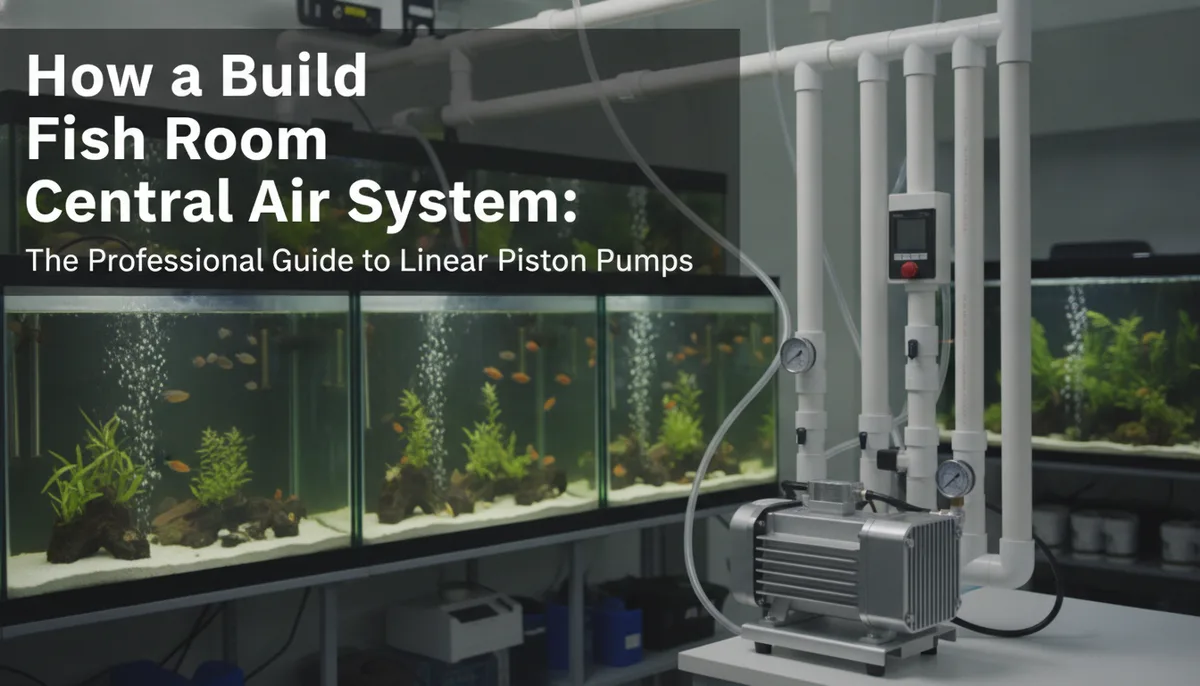
How to Build a Fish Room Central Air System: The Professional Guide to Linear Piston Pumps
The Evolution of the Professional Fish Room
Owning a fish room is a milestone for any serious aquarist. Whether you are breeding rare cichlids, raising high-grade shrimp, or maintaining a collection of Best Rimless Aquariums for a Modern Home Aesthetic, the complexity of managing multiple tanks grows exponentially with every new addition. One of the most significant hurdles is managing life support systems—specifically, how to provide oxygen and filtration to every enclosure without creating a chaotic web of power strips and noisy, vibrating air pumps.
The solution used by veteran hobbyists and retail stores alike is the central air system. Instead of plugging in an individual hang-on-back filter or a small diaphragm pump for every tank, a central system utilizes a single, powerful linear piston air pump. This pump feeds a pressurized "loop" of PVC pipe that runs around the perimeter of the room, allowing you to "tap" into the air supply wherever a tank is located.
Why Linear Piston Air Pumps Are the Gold Standard
When designing a central air system, the heart of the operation is the pump. While industrial blowers exist, they are often overkill for home fish rooms and can be incredibly loud. Diaphragm pumps, on the other hand, tend to wear out quickly when pushed to their limits and lose pressure over long distances.
Linear piston air pumps, such as the LPH45 linear piston air pump, are the preferred choice for several reasons:
- Efficiency and Economy: They move a massive volume of air using very little electricity.
- Quiet Operation: Unlike the frantic vibration of a diaphragm pump, linear piston pumps operate with a smooth, low-frequency hum that is easily ignored.
- Durability: These pumps are designed for 24/7 operation and are nearly maintenance-free, often lasting years without needing internal part replacements.
- Scalability: If your fish room expands beyond the capacity of one pump, these units can be installed in series to provide an added boost to the same PVC loop.
Sizing Your Pump: The "1 Liter Rule"
Estimating air requirements is notoriously difficult because air pressure needs vary based on tank depth and the specific resistance of your air stones or sponge filters. However, a reliable industry estimate is that 1 liter of air per minute can power 1 air stone.
For example, the LPH45 outputs 47 liters of air per minute, making it suitable for roughly 47 standard tanks. If you are running deep 300-gallon tanks, you will need more pressure to overcome the weight of the water, meaning the pump will support fewer outlets. Conversely, if you are running a rack of shallow 5-gallon fry tanks, you may be able to power significantly more.
Designing the PVC Loop for Maximum Efficiency
The most effective way to distribute air is through a closed-loop system. Instead of a single pipe that ends at the last tank (a "dead-end" system), a loop starts at the pump, travels around the room, and returns to connect back to itself.
Why a Loop?
A loop ensures that air pressure is equalized throughout the entire system. In a dead-end system, the tanks furthest from the pump often suffer from lower pressure. In a loop, air reaches every valve from two directions, minimizing "pressure drop" and ensuring that the sponge filter in the far corner of the room bubbles just as vigorously as the one right next to the pump.
Elevation Matters
We recommend mounting the PVC loop high on the wall, close to the ceiling. This is not just for aesthetics or to keep the floor clear of trip hazards; it serves a vital safety function. By keeping the air source higher than the water level of the tanks, you create a natural gravity barrier. If the power goes out, water cannot siphon up the airline tubing and into your main PVC line or pump. This allows you to skip the installation of individual check valves, which are notorious for failing or reducing air pressure.
Essential Materials for Your Central Air System
Building this system requires a trip to the hardware store and a few specialized aquarium components.
The Core Components
- Linear Piston Air Pump: The LPH45 is the standard for mid-sized fish rooms.
- 1” PVC Pipe: This diameter is ideal for creating a "reservoir" of air. Using anything smaller than 3/4” can restrict volume and cause the pump to back-pressure, shortening its lifespan.
- PVC Fittings: You will need elbows for corners, couplings to join lengths of pipe, and a "tee" fitting to connect the pump to the loop.
The Connection Hardware
To bridge the gap between the rigid PVC and your flexible airline tubing, you will need:
- Metal Air Valves: These are threaded or press-fit into the PVC. Aquarium Co-Op metal air valves are a popular choice for their durability.
- ¾” Vinyl Tubing: This connects the pump's output to the PVC loop, acting as a vibration dampener.
- Plastic Inline Air Valves: These are placed on the airline tubing leading to each tank to allow for fine-tuned control of the airflow.
Tools for the Job
- Electric Drill: Used with a 3/16” drill bit for installing the metal valves.
- PVC Pipe Cutter: A dedicated 1 inch PVC pipe cutter ensures clean, square cuts that won't leak air.
- PVC Cement: To permanently seal the loop.
Step-by-Step Installation Guide
1. Positioning the Pump
Place your linear piston air pump on a solid, level surface. While these pumps are quiet, placing them on a piece of foam or a rubber mat can further reduce any transferred vibration. Ensure it is located near a power outlet and has enough clearance for ventilation.
2. Building the Perimeter Loop
Dry-fit your 1” PVC pipe along the perimeter of your room. Use 1” conduit straps to secure the pipe to the wall near the ceiling. If you are worried about finding studs, a stud finder is helpful, but since the pipe is light (it only holds air), drywall anchors are often sufficient. Once the layout is perfect, use clear PVC cement to glue the joints.
3. Connecting the Pump to the Manifold
Use a PVC tee fitting to create an entry point in the loop. You will use a combination of a threaded adapter and a barbed hose adapter to connect the 3/4" vinyl tubing from the pump to the PVC pipe. Secure the vinyl tubing at both ends with hose clamps to prevent it from blowing off under pressure.
4. Tapping the Line
This is the most time-consuming part. For every tank location, drill a hole into the PVC pipe using a 3/16” drill bit. Screw your metal air valves directly into the holes. The PVC is soft enough that the metal valves will self-tap and create a seal.
5. Running Airline Tubing
Run standard airline tubing from the metal valves down to your tanks. For the best results, install a plastic inline valve on each line. This allows you to adjust the bubbles in a specific tank without having to reach up to the ceiling-mounted PVC loop.
Maintaining Your System for the Long Haul
One of the greatest benefits of a central air system is the low maintenance requirement. However, to keep your fish room running smoothly, keep these tips in mind:
- Clean the Pump Filter: Most linear piston pumps have a small foam air intake filter. Check this every few months and wash it out to ensure the pump isn't struggling to "breathe."
- Check for Leaks: Periodically spray your PVC joints with soapy water. If you see bubbles, you have an air leak that is wasting electricity and reducing pressure.
- Monitor Heat: Like any high-quality equipment, such as those discussed in our Eheim Jager Heater Review, the pump can generate some heat during operation. Ensure the room has decent ventilation to prevent the pump from overheating.
By investing the time to install a central air system, you transition from a "collector of tanks" to a professional "fish room operator." The stability, quietness, and efficiency of a linear piston pump will allow you to focus more on the health of your fish and less on the maintenance of your hardware. Whether you are battling potassium deficiency in your plants or preparing to fly with live fish, a reliable air supply is the foundation of your success.