
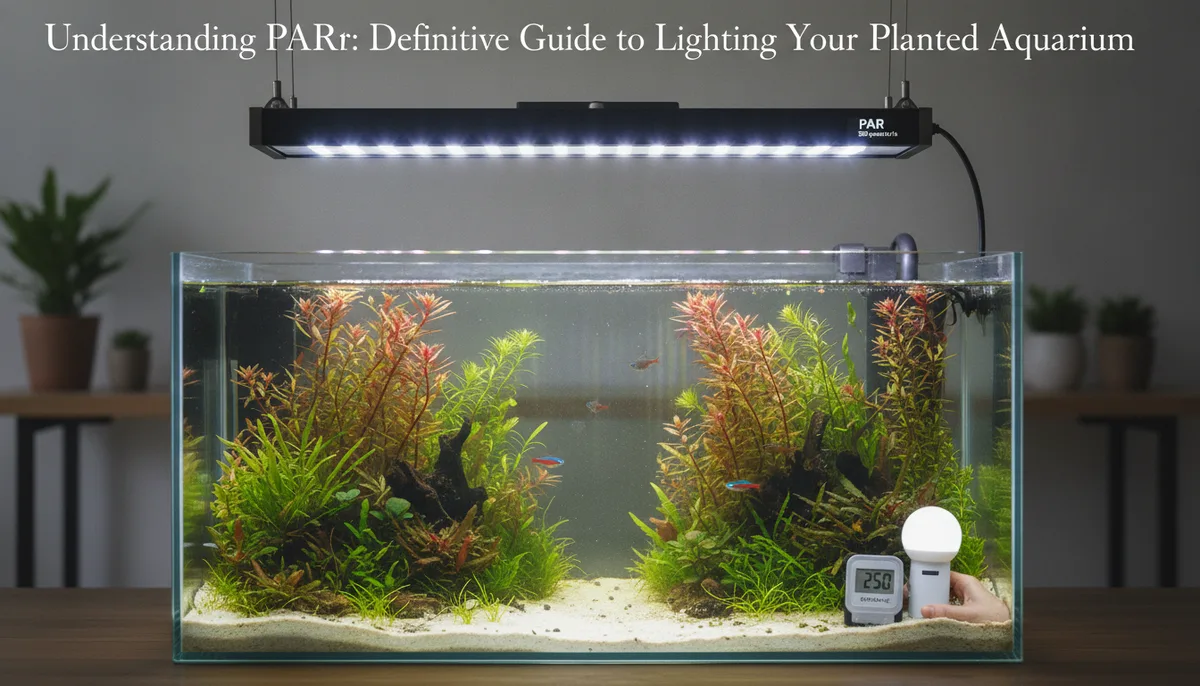
Understanding PAR: The Definitive Guide to Lighting Your Planted Aquarium
When you first step into the world of planted aquariums, the sheer variety of lighting options can be overwhelming. You’ll see terms like "full spectrum," "lumens," "kelvin," and "watts per gallon." However, if you want to move past the guesswork and truly understand whether a light fixture can sustain your favorite aquatic mosses or demanding red stem plants, there is one metric that stands above the rest: PAR.
Understanding PAR is the "secret sauce" used by professional aquascapers to ensure their plants thrive while keeping unsightly algae at bay. In this guide, we will break down what PAR is, why it matters more than traditional brightness metrics, and how to use it to choose the perfect light for your specific setup.
Defining PAR: Light Through the Eyes of a Plant
To the human eye, a light might look incredibly bright, but to a plant, it could be virtually useless. This is because humans and plants "see" light differently.
PAR stands for Photosynthetically Active Radiation (sometimes referred to as Photosynthetically Available Radiation). While we use "lumens" to describe how bright a light appears to us, PAR quantifies the intensity of light that plants actually use to fuel photosynthesis.
Specifically, PAR measures the number of photons within the 400–700 nanometer (nm) wavelength range. This range is the "sweet spot" where chlorophyll and other plant pigments absorb energy to convert water and carbon dioxide into food.
PPFD: The Unit of Measurement
In the hobby, when we talk about a light's "PAR value," we are usually referring to Photosynthetic Photon Flux Density (PPFD). This is measured in units of μmol/m2/s (micromoles per square meter per second). This tells us exactly how many "useful" light particles are hitting a specific square meter of your aquarium every second.
digital PAR meter for aquarium use
The Inverse Square Law: Why Depth Changes Everything
One of the most common mistakes beginners make is assuming a light fixture will perform the same on every tank. PAR is not a static number for a light fixture; it is highly dependent on the distance between the light source and the plant.
As light travels through water, it is absorbed and scattered. This means that a light positioned 12 inches above the substrate will provide a significantly higher PAR value than that same light positioned 24 inches above the substrate.
If you are setting up a deep tank, you will need a much more powerful light to achieve the same PAR levels at the bottom as you would in a shallow "long" style tank. This is a crucial consideration when choosing your hardware, especially if you are looking at Best Rimless Aquariums for a Modern Home Aesthetic, as their dimensions can vary wildly.
Categorizing Light Levels: Low, Medium, and High
To make things easier for hobbyists, the industry generally categorizes aquarium plants into three lighting tiers based on the PAR they receive at the substrate level. Knowing where your tank falls on this scale will dictate your maintenance routine and your plant selection.
Low Lighting: 10–20 PAR
This is the "safe zone" for beginners and those who prefer a low-maintenance lifestyle. At this level, you are providing just enough light for hardy, slow-growing species.
- Ideal Plants: Anubias, Java Fern, and Cryptocoryne species.
- Requirements: Minimal fertilization and no CO2 injection are necessary.
- The Benefit: Because the light energy is low, the plants grow slowly, and algae struggles to take hold. This results in a stable environment that requires less frequent trimming and water changes.
Medium Lighting: 20–35 PAR
Most "standard" planted tanks fall into this range. It is a versatile middle ground that allows for a much wider variety of plant species.
- Ideal Plants: Amazon Swords, Vallisneria, and some hardier stem plants.
- Requirements: Fertilization becomes essential here. As the light increases, the plants' metabolism speeds up, and they will quickly deplete the nutrients in the water.
- The Benefit: You get faster growth and more lush colors. While CO2 is not strictly required, adding it will result in significantly healthier plants.
High Lighting: 40–50+ PAR
This is the realm of "high-tech" aquascaping. High light levels are used to achieve dense carpets and vibrant, fiery red coloration in plants.
- Ideal Plants: Dwarf Hairgrass, HC Cuba, and Rotala Rotundifolia (to achieve red hues).
- Requirements: CO2 injection is a necessity. Without supplemental carbon, the plants cannot utilize the intense light energy, leading to a massive algae bloom. A rigid fertilization schedule is also required.
- The Benefit: You can grow almost any plant in the hobby and create the breathtaking, high-contrast layouts seen in international aquascaping competitions.
high intensity LED aquarium light for high tech tanks
The Relationship Between PAR, CO2, and Algae
Many hobbyists believe that "more light equals better plants," but in the aquarium, light acts as the accelerator pedal. If you push the pedal to the floor (High PAR) but don't have any fuel in the tank (CO2 and nutrients), the "engine" will fail. In an aquarium, that failure manifests as algae.
When PAR levels are high, plants attempt to photosynthesize at a rapid rate. If they run out of Carbon Dioxide or essential minerals like Potassium, they stop growing. However, algae is much more opportunistic. Algae will happily use the excess light and the tiny bits of nutrients the plants left behind to take over your tank.
If you notice your plants struggling despite having "great" lights, you might be dealing with a nutrient deficiency rather than a light issue. For instance, if you see small holes appearing in your leaves, you should check out our guide on Why Your Aquarium Plants Have Pinholes: The Ultimate Guide to Potassium Deficiency.
How to Choose Your Next Light Based on PAR
When shopping for a new light, don't just look at the wattage. Instead, look for a PAR chart provided by the manufacturer. A reputable brand will show you the PAR levels at different depths (e.g., 12", 18", and 24").
- Measure Your Tank Depth: Determine the distance from where the light will sit to the top of your substrate.
- Identify Your Plant Goals: Are you looking for a low-tech jungle or a high-tech red Iwagumi?
- Check the Chart: Find a light that provides the target PAR for your plant goals at your specific tank depth.
If you are looking for specific recommendations across different price points, we have a detailed breakdown of the Best LED Aquarium Lighting for Planted Tanks: Budget vs. Professional Grade to help you make an informed decision.
Fluval Plant 3.0 LED Light
Practical Tips for Managing PAR in Your Tank
If you find that your light is too powerful for your current setup and you're fighting algae, you don't necessarily need to buy a new fixture. Here are a few ways to manage PAR effectively:
- Dimming: Most modern LED fixtures come with built-in dimmers. Reducing the intensity to 60% or 70% can bring a "High Light" fixture down into the "Medium Light" range.
- Floating Plants: Using floating plants like Frogbit or Salvinia is a natural way to shade low-light plants like Anubias that are prone to getting spot algae under direct, intense light.
- Adjusting Height: If your light is on a hanging kit, raising it just a few inches can significantly drop the PAR levels at the substrate.
- Photoperiod: While PAR measures intensity, the "photoperiod" (how long the lights are on) also matters. Most planted tanks thrive with 6–8 hours of light. If you have high PAR, you may need a shorter photoperiod to prevent algae.
Conclusion: PAR as the Gold Standard
PAR is the most reliable way to bridge the gap between scientific light measurement and practical plant growth. By understanding that light intensity decreases with depth and that higher intensity requires a corresponding increase in CO2 and nutrients, you can avoid the most common pitfalls of the planted tank hobby.
Whether you are building a simple low-tech sanctuary for your The Best Small Catfish for Community Aquariums or a high-energy competition scape, let PAR be your guide. It takes the guesswork out of the equation, ensuring your plants have exactly what they need to thrive.